 Ashoka Pillar, Sarnath
Ashoka Pillar, Sarnath - The Symbol of India’s Heritage and Buddhist Legacy
The Ashoka Pillar is one of the most important symbols of ancient India, built by Emperor Ashoka during the Mauryan era. It features inscriptions promoting peace, dharma, and ethical governance. Today, it stands as a national emblem representing unity, justice, and moral values.
Ashoka Pillar, Sarnath
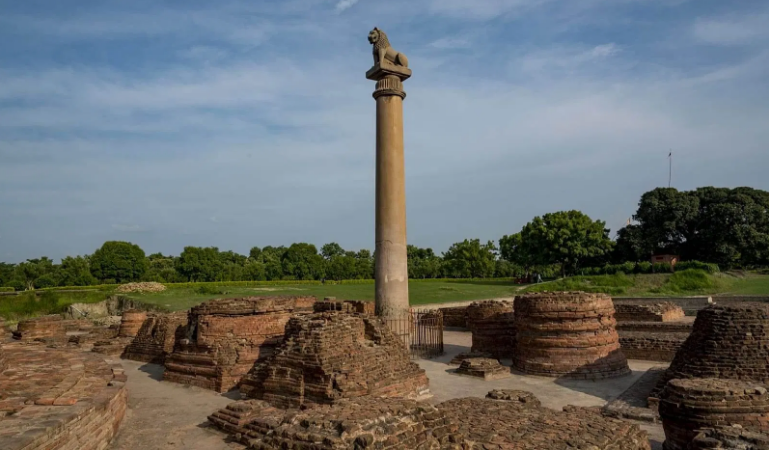
The Ashoka Pillar at Sarnath is one of India’s most iconic historical monuments, representing truth, non-violence, and the birth of Buddhism. It was originally built by Emperor Ashoka in the 3rd century BCE, shortly after he embraced Buddhism. This pillar once stood proudly near the Dhamek Stupa, marking the sacred spot where Lord Buddha delivered his first sermon.
Though the pillar is now broken, its lower portion still stands at Sarnath, while the famous Lion Capital-India’s National Emblem-is preserved in the Sarnath Museum.
History & Significance
The Ashoka Pillar is deeply connected to India’s cultural and spiritual heritage.
Built by Emperor Ashoka (circa 250 BCE) after his visit to Sarnath.
Marks the place where Buddha began teaching the Four Noble Truths.
The pillar carried Ashoka’s teachings engraved in Brahmi script.
The original Lion Capital with four lions symbolizes courage, unity, and peace.
Declared India’s National Emblem on 26 January 1950.
It stands as a reminder of Ashoka’s transformation from a conqueror to a promoter of peace.
Architecture of the Ashoka Pillar
The pillar was a masterpiece of Mauryan craftsmanship:
- Carved from a single block of polished sandstone.
- Around 50 meters tall in its original form.
- The surface had a glass-like sheen known as Mauryan polish.
- The capital included:
- Four standing lions
- A circular abacus decorated with a horse, bull, lion, and elephant
- A wheel (Ashoka Chakra) representing Dharma
The design reflects harmony, strength, and the eternal cycle of life.
What to See Today
Even though the pillar no longer stands in full height, visitors can see:
1. The Base of the Ashoka Pillar: Located near Dhamek Stupa, protected under a metal enclosure.
2. The Original Lion Capital: Preserved in Sarnath Museum, the pride of India.
3. The Ashoka Chakra: Now part of the Indian national flag.
4. Ancient ruins nearby: Including monasteries, stupas, and engraved stones that reveal the journey of Buddhism.
Best Time to Visit
October to March - Pleasant weather
Morning or late afternoon - Best for photos and peaceful sightseeing
Nearby Attractions
- Dhamek Stupa
- Chaukhandi Stupa
- Sarnath Museum
- Mulagandha Kuti Vihar
- Thai, Japanese, and Tibetan Buddhist temples
- Deer Park
Travel Tips
- Visit the Sarnath Museum to see the original Lion Capital.
- Respect the protected archaeological area.
- Photography is allowed outside but restricted inside the museum.
- Wear comfortable footwear for walking around archaeological sites.
 5 Places to Visit in February wi..
 Explore the Wild Beauty of Saris..
 Jaipur - The Pink City of India:..
 Adalaj Stepwell, Gandhinagar - T..
 Kurukshetra - The Sacred Land of..
 Valparai - Best Tourist Places, ..
 Radha Raman Temple Vrindavan - E..
 Sankat Mochan Hanuman Temple, Va..
 Bodhi Tree - The Sacred Tree of ..
 Banke Bihari Temple Vrindavan | ..
 Junagadh, Gujarat - A Heritage C..
 Humayun's Tomb Dehi - Before the..
 Madan Mohan Temple Vrindavan –..
 Anamalai Tiger Reserve (Topslip)..
 Kodaikanal - The Princess of Hil..